See it before your fish do
The surface always looks fine. It's the deep water that kills fish.
Lakelytics watches your lake's dissolved oxygen 24/7 — day and night, top to bottom — and warns your phone before a crash becomes a fish kill. It can even switch your aerator on automatically.
- ✓ No mains power or Wi-Fi needed
- ✓ Alerts day & night
- ✓ Low-maintenance optical sensor
▲ All levels healthy
Live in the Lakelytics app · illustrative readings
What Lakelytics is
Continuous oxygen monitoring that warns you first
Lakelytics is a low-maintenance, 24/7 water-monitoring system for carp lakes and fisheries. A solar-powered sensor station measures the water and sends readings wirelessly to the cloud. You see live data on your phone and get alerts before low oxygen becomes a fish kill — and it can switch an aerator on automatically or remotely.
The 4am danger zone
Why healthy-looking lakes still lose their fish
On a warm, still night, plants and algae stop making oxygen and start consuming it. Levels fall through the small hours and bottom out around dawn — long after you’ve gone home. By the time the surface shows trouble, it’s often too late.
Without monitoring
You find out at the water’s edge
- ✕ Oxygen crashes overnight, unseen
- ✕ First sign is fish gasping at the surface
- ✕ Aerators only run if someone remembers
- ✕ A single hot night can wipe out years of stocking
With Lakelytics
You get warned while you sleep
- ✓ Deep-water oxygen tracked minute by minute
- ✓ Phone alert the moment it trends low
- ✓ Aerator kicks in automatically, day or night
- ✓ Act with hours to spare, not minutes
How it works
From the deep water to your phone in four steps
- 01
The sensor station senses
A solar-powered sensor station sits on your lake with a probe in the deep water, reading dissolved oxygen and temperature continuously — including the cool, deep layer that crashes first.
- 02
Wireless to the gateway
Readings travel over a secure, long-range wireless link to a small site gateway. No mains power, Wi-Fi or cabling needed at the water’s edge.
- 03
Gateway to the cloud
The gateway backhauls your data to the cloud over 4G or Ethernet. We supply the SIM and connectivity — nothing for you to set up.
- 04
You see it and act
Live data and phone alerts land in the Lakelytics app. When oxygen dips, get warned instantly — or let the station switch your aerator on automatically.
On your phone & the web
Your whole lake, in the palm of your hand
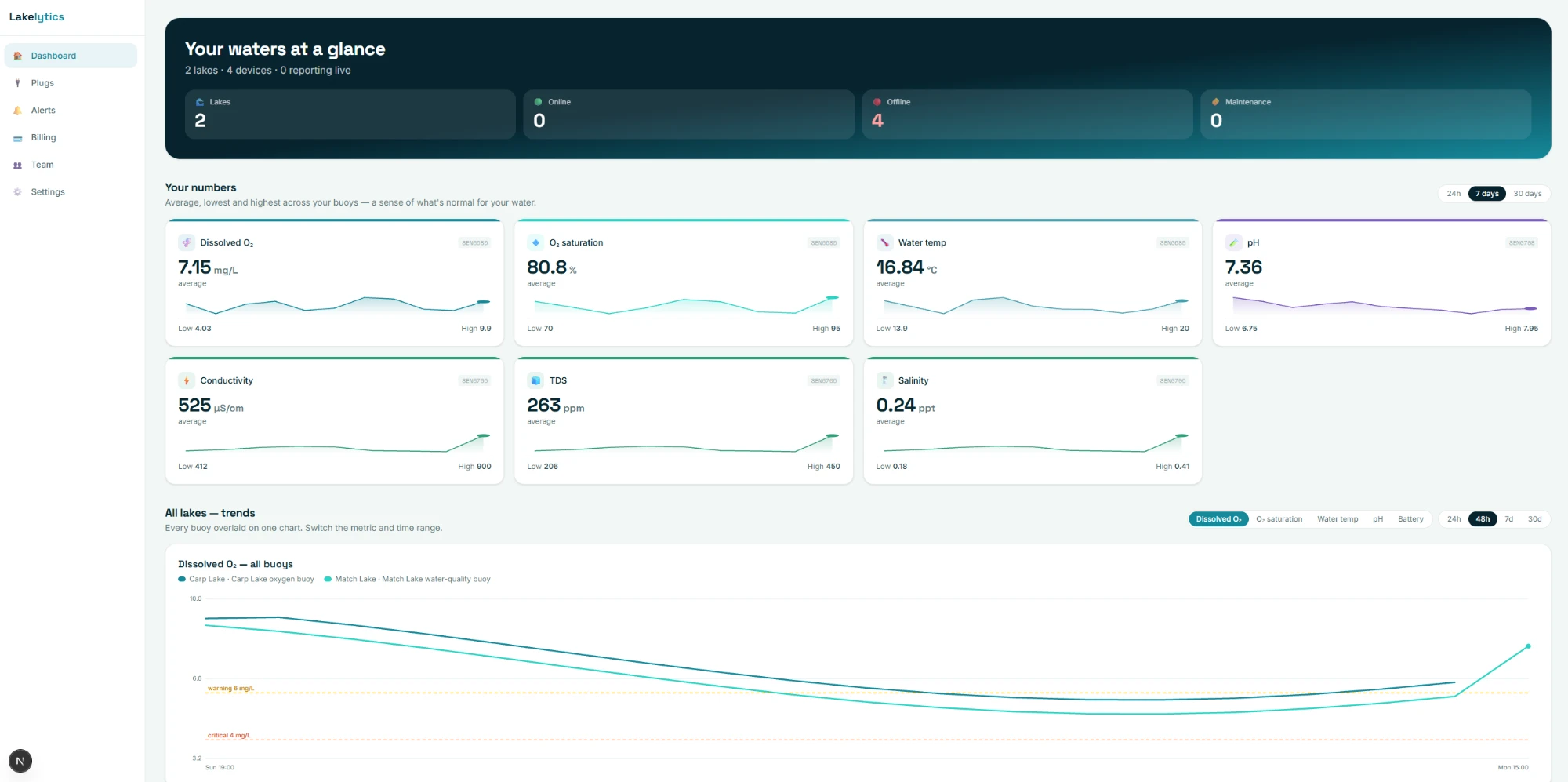
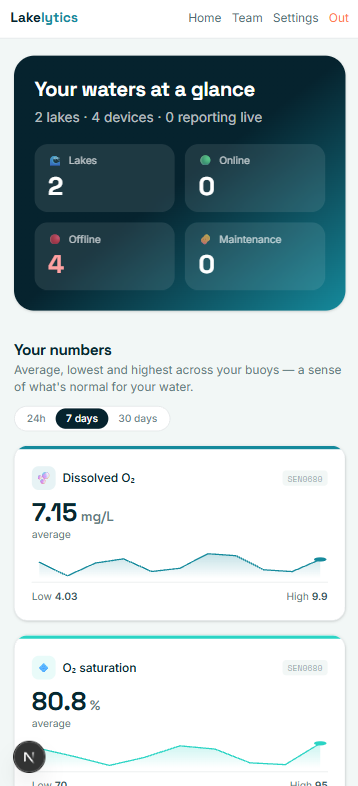
The same live water, trends and controls on a full web dashboard and a native app for iPhone and Android — wherever you are, day or night.
Why fisheries choose Lakelytics
Built for real lakes, not labs
Alerts day and night
Push, SMS, WhatsApp and email the instant oxygen trends toward danger — plus an automated phone call for critical alerts — so you can act before dawn, not after.
Automatic aeration
Link a remote smart plug and let Lakelytics start your aerator automatically when oxygen drops, then stop it when it recovers.
No power at the water
Solar power and long-range wireless mean no mains, no Wi-Fi and no trenching at the lakeside.
Low maintenance
Optical DO sensing — no electrolytes to replace. Just an occasional wipe-down, with reminders you log in the app.
One dashboard, many lakes
Watch every station and every water from a single phone app or web dashboard, wherever you are.
We handle connectivity
The SIM and data are included. It arrives configured — self-install with phone support, or we’ll install it for you.
Choose your sensors
One station, the sensors you choose
Every station reads dissolved oxygen — the reading that prevents fish kills. Add pH and conductivity on the same probe when you want the fuller picture.
Dissolved oxygen
IncludedThe reading that prevents fish kills — plus % saturation and water temperature, all from one optical probe. Included as standard on every station.
pH
Add-onOptional add-on. Adds pH with automatic temperature compensation for a fuller picture of your water chemistry.
Conductivity / TDS / salinity
Add-onOptional add-on. Tracks dissolved solids and salinity on the same probe bus — handy for spotting run-off, leaks or long-term water-quality trends.
Need an unusual sensor, or a tricky off-grid site? Talk to us — we cater for any lake, any setup.
How many stations?
One station covers most day-ticket carp waters
As a working rule, one sensor station comfortably covers a typical small, single-basin carp lake — roughly up to 2–4 acres (about 1–2 hectares) of fairly uniform water, provided it’s placed well. Put it where oxygen drops first: the deepest area, the most sheltered corner out of the wind, the weediest zone, and away from any aerator. One station in that canary spot beats three in easy-to-reach places.
Add a second station for lakes over ~4 acres, separate bays or basins that don’t freely mix, long or narrow shapes, distinct problem areas, or very high-value stock where you want redundancy.
Common questions
Answers before you ask
What does Lakelytics actually measure?
Every Lakelytics sensor station measures dissolved oxygen and water temperature continuously — dissolved oxygen is included as standard. pH and conductivity/TDS/salinity are optional add-ons on the same sensor bus.
Do I need mains power or Wi-Fi at the lake?
No. The sensor station is solar powered with a built-in battery, and it sends readings over a secure, long-range wireless link to a small site gateway. The gateway connects to the internet by Ethernet, Wi-Fi or a 4G/LTE mobile signal — and can run on solar too — so you only need a connection at the gateway, never at the water.
How does it warn me before a fish kill?
Lakelytics sends alerts to your phone the moment oxygen drops toward a dangerous level — day or night. Because dissolved oxygen usually crashes before dawn, the sensor station watches while you sleep and can automatically switch on an aerator through a remote smart plug.
How much maintenance does it need?
Very little, and it is transparent. Day to day it is a monthly wipe-down to clear fouling — the app reminds you and lets you log it from your phone. The sensors are a serviceable item: once a year we supply brand-new, lab-calibrated replacements for a small fee, and they swap in with two bolts.
How big a lake does one sensor station cover?
As a rule of thumb, one sensor station comfortably covers a typical small, single-basin fishing lake up to roughly 2–4 acres (1–2 hectares) of fairly uniform water. Larger lakes, separate bays or basins, and long or narrow shapes benefit from a second sensor station.
Where does Lakelytics work, and where is my data stored?
Lakelytics is a global service — we support fisheries and water managers across the UK, Europe and the United States. We run infrastructure in both the UK and the USA, so your alerts are fast and your data is stored in-region. Anywhere with sunlight and a mobile signal can be monitored.
More in the full FAQ.
Part of the Lakelytics family
Also from us: ChipACarp
Fish tagging, catch logging and theft protection for fisheries and anglers — PIT tags and a modern app, plus shareable fish passports and a live catch feed for your website.
Protect your stock before the next hot night
Book a 15-minute demo and we’ll show you exactly how Lakelytics would watch your water — or call and talk it through today.